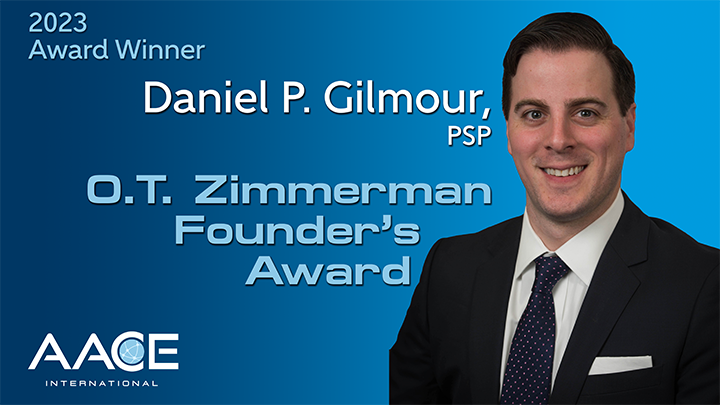
Daniel P. Gilmour Named O. T. Zimmerman Founder’s Award Recipient

Dan joined AACE in 2013. He obtained the Planning & Scheduling Professional (PSP) designation in 2014. He has served as the chair of the Rising Professionals Committee for two terms. Dan is active in the Planning & Scheduling Technical Subcommittee and has been serving as the subcommittee’s chair (2022-present)…

Share

Daniel P. Gilmour Named O. T. Zimmerman Founder’s Award Recipient Read More »
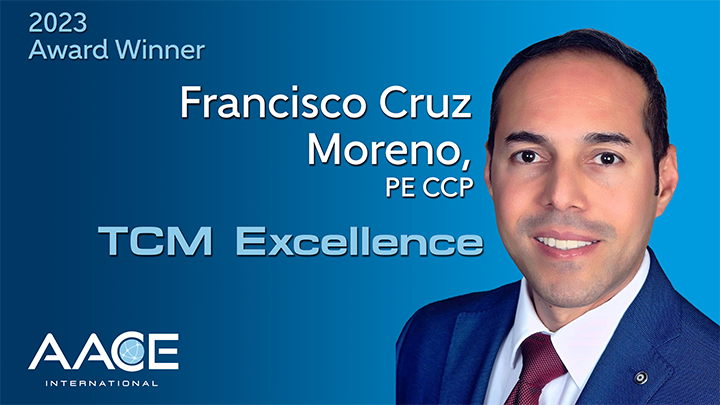
Nicole Johnson Named Outstanding Woman in AACE International

Nicole has been a member of AACE since 2016 and has committed to the organization in various facets, including her roles as Secretary and Vice President of the Delaware Valley Section of AACE, as a board member of the Women in Project Controls Committee (WPC) and as an instrumental participant in the planning and execution of the Regional 2 Symposium for several years…

Share

Nicole Johnson Named Outstanding Woman in AACE International Read More »

Source Extra

In Memoriam, May 2023

Kenneth King Humphreys of Morganton, NC, has finished his earthly journey. In his 85 years he tackled many engineering, preaching, and community service projects with intense energy, determination and expertise. After graduation from Carnegie Institute of Technology, he received a master’s degree from West Virginia University and a doctorate from Kennedy Western University…

Share

In Memoriam, May 2023 Read More »

Source Extra

New RP 130R-23: Demonstrating Entitlement to Cumulative Impact Claims in Construction

This recommended practice (RP) of AACE International provides guidance on the process to demonstrate entitlement to cumulative impact claims on a construction project when a process for addressing cumulative impact claims is not addressed in the contract terms. This process applies across all common construction contracting strategies or delivery methods if the contract terms do not address any or some aspects of the procedure to address cumulative impact claims…

New RP 130R-23: Demonstrating Entitlement to Cumulative Impact Claims in Construction Read More »

Source Extra

New RP 129R-23: Linear Scheduling Methods (LSM)

Project planning and scheduling professionals use a variety of project scheduling methods depending on the type, size, and nature of projects. Linear scheduling methods (LSM) are typically used on projects wherein the majority of the scope is made up of highly repetitive work elements along a horizontal or vertical alignment. Examples of these projects include pipeline, tunnel, airport runway, highway, transmission line, road resurfacing, railroad, or high-rise construction projects. An LSM schedule (also known as a linear schedule, march chart, or time chainage diagram) is the graphical output of the LSM. Linear schedules use velocity diagrams, which are described below, to represent each activity and the progress rate to be achieved (or the progress actually achieved) over time. The schedule format typically provides planned and/or actual production rates on a time-scaled, linear format…

New RP 129R-23: Linear Scheduling Methods (LSM) Read More »